Solve planner staffing shortages without extra hires
Chainfill removes manual retyping from the chain so your current planners can handle more orders.
3x
More capacity
Without extra hires
80%
Faster processing
Per order file into your TMS
Planner staffing shortage: what you already see, in numbers
Vacancies for planners stay open and your current team is already at full capacity, while orders keep arriving by email, PDF, and attachments. You're not alone: in Q3 2025, per UWV/STL, there were approximately 11,000 open vacancies for transport planners and logistics workers in the Netherlands, with nearly every region classified as a 'very tight' labour market. ROA forecasts through 2030 point to more tightness, not less. And logistics teams spend an average of 4+ hours per day on manual data entry.
Hiring more planners isn't a scalable answer anymore. Reclaiming those hours is, and that's where solving the planner staffing shortage actually starts.
Source: UWV / STL Sector Monitor T&L Q3 2025; ROA labour-market forecast 2025-2030.
Where the planner's day goes back
Planner inbox
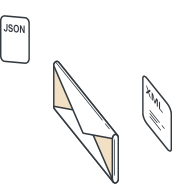
Email, PDF, EDI
- Read
Chainfill AI
Parse, validate, flag
- Push
Planning + TMS
Direct push, exceptions tagged
Inbound orders no longer wait for a planner to retype them. AI reads any format, flags only what needs a human eye, and pushes the rest straight to your TMS. For transport planners, that turns order entry automation from a backlog item into a working part of the daily queue.
Where planners lose time
- 01
Manual retyping of order files between email, PDF, and TMS eats a large share of your planners' workday.
- 02
Errors that only surface at the driver or the customer, leading to return trips, rework, and frustrated customers.
- 03
No room for the work planners are genuinely indispensable for: exceptions, prioritising, and customer contact.
From inbox to dispatched order
- 1
Orders arrive in one inbox
Email, EDI, and PDF order files all land in the same Chainfill inbox without per-channel routing.
- 2
AI reads any layout
Field meaning is recognised regardless of customer template, so a new shipper doesn't trigger a new mapping project.
- 3
Planner reviews edge cases only
Low-confidence fields surface in a short review queue. Confident extractions are pushed automatically.
- 4
Order lands in the TMS
Validated records flow directly into your TMS in the format it already accepts, ready to dispatch. No schema changes on your side, no parallel database to maintain.
Ready to remove the manual work?
Book a demo“What used to take our team hours now moves through Chainfill automatically. We spend less time retyping data and more time on the work customers notice.”
What planners get back once order entry runs on its own
Document handling is the biggest time-sink for most planners. This is the capacity Chainfill customers reclaim, measured per employee per day.
4+ hrs
Manual data entry from paper documents, emails, and PDFs into the TMS.
15 min
Automated extraction, validation, and TMS update. Only exceptions need a planner's attention.
Hours that flow back into route planning, customer contact, and exception handling: the work planners are indispensable for.
The same planning team can move roughly three times the order volume once retyping leaves the chain. Hours flow back into route planning, customer calls, and exception handling, the work planners are indispensable for.
Source: Chainfill customer comparison, averages over data entry before and after deployment.