Filogic TMS automated order entry
Hand Chainfill two sample orders, then fields land directly in Filogic. No per-partner field mappings, no schema changes to your TMS.
Straight into Filogic
Over the Filogic API
No plugin, no schema changes
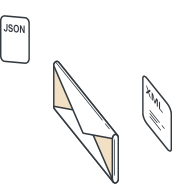
PDF, email, EDI
Incoming streams
All into the Filogic field layout
Where Filogic users stay manual
Filogic covers the TMS work well once the order is in. The gap is on the way in: hand-written mappings per partner work for the first twenty suppliers, but stop being scalable around partner #20. Every new supplier is a new mapping script, written, reviewed and maintained by someone who knows that partner's quirks.
Silent schema drift makes it worse: a partner adds a field, renames an attribute or switches a unit, and the mapping fails downstream with no clear error. Chainfill fills that gap with AI extraction and mock-tested field mappings, without replacing Filogic itself.
See also: Chainfill Transforms, for the broader AI-mapping approach.
How Chainfill feeds Filogic
Inbound orders
PDF, email, EDI
- Read
Chainfill AI
Map to Filogic fields
- Validated rows
Filogic TMS
Over the Filogic API
Inbound order streams pass through Chainfill's AI extraction, validate against the Filogic field layout, then land over the Filogic API. No per-partner script in IT. The whole Filogic integration runs through one Chainfill pipeline so new partners can plug in without IT cycles per source.
Where Filogic users get stuck
- 01
Every new partner or customer means manual retyping until IT builds a mapping.
- 02
PDF orders and email attachments still need a human. Chainfill adds AI extraction for those document streams on top of Filogic.
- 03
Per-partner field mappings break silently with small schema changes.
Onboarding a Filogic partner in days
- 1
Two sample orders
Ops hands over two real orders from the partner in whatever format they send. No spec exchange, no plugin install.
- 2
AI proposes the mapping
Chainfill recognises field meaning and proposes the Filogic field mapping. Splits, concatenations, and array iterations are surfaced in a diff view.
- 3
Mock-server verification
Run the proposed mapping against the Filogic field layout in the built-in mock server. Adjust where needed before anything goes live.
- 4
Live over the API
Switch the stream on. Records flow into Filogic over the existing API, with no plugin or schema change required. When a partner's format drifts later, Chainfill warns before the order breaks downstream in Filogic.
Ready to remove the manual work?
Book a demo“Chainfill helps us register new transports faster and with fewer manual checks. Finn and Yorick listen carefully and turn feedback into concrete improvements.”
Partner onboarding in Filogic, before and after Chainfill
The difference is who builds the mapping and how fast a new partner can go live.
Mapping in IT
Engineer reads the partner spec, writes mapping code, handles edge cases and maintains the script. Waiting in line behind other IT work.
AI mapping
Ops hands over two sample orders, Chainfill proposes the mapping, you verify in the mock server, and the stream goes live.
Qualitative framing based on where IT time is lost in classical onboarding. Actual lead time depends on your partner mix and how complex the source formats are.
New partners no longer wait for an IT slot to be mapped into Filogic. Ops can move from sample to live within days, with mappings that adapt as partner formats drift instead of breaking silently.
Qualitative, based on the Filogic onboarding workflow.