Automate container transport documents
Bills of Lading, CMRs, customs documents, and transport orders pass through dozens of parties and formats. Chainfill turns that into one structured stream.
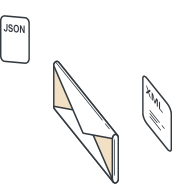
Every format
Source-agnostic
B/L, CMR, customs, or scan of a scan
One schema
Into your TMS
No per-partner or per-terminal template
The container chain still runs largely on paper and PDF
Open Trip Model and eCMR are only half-real in container transport. In 2022 just 638,852 eCMRs were issued in the Netherlands, just over 1% of all freight notes. For forwarders and container carriers that means B/Ls, CMRs and customs schedules still arrive as paper, PDF attachments or legacy EDI.
One wrong reference or one delayed update and the container sits. Demurrage and detention costs are the direct price of manual retyping between carrier, forwarder, terminal, and TMS.
Every document stream into one pipeline
Bills of Lading
PDF / scan
CMRs
Paper, eCMR, scan
Customs schedules
EDIFACT, XML
Booking confirmations
Email + attachments
Chainfill AI
Cross-checked, pushed to TMS
Bills of Lading, CMRs, customs schedules, and booking confirmations converge into a single AI pipeline that validates references and pushes structured records to your TMS. That single pipeline is what container freight document automation looks like once paper, PDF, and EDI all converge in one place.
Where things go wrong in the container chain
- 01
Documents arrive in dozens of formats: PDF, email, EDIFACT, scan of a scan.
- 02
Terminal appointments, customs schedules, and TMS fields all need to match while humans key them in by hand.
- 03
One wrong reference and the container sits, with demurrage as the bill.
From inbound document to live container record
- 1
Capture every source
Inbound channels (carrier portals, mailboxes, EDI feeds, terminal exports) all land in one inbox without per-source plumbing. PDF, EDIFACT, XML, scans, and even a photo from a phone all normalise to one schema.
- 2
Read regardless of layout
AI extracts container, booking, and customs fields whether the document is a fresh eCMR or a scan-of-a-scan.
- 3
Validate up front
References, weights, and terminal appointments are cross-checked against your TMS and terminal feeds before the record goes live.
- 4
Flag anomalies fast
Inconsistencies reach the right operator the moment they appear, not at the terminal gate.
Ready to remove the manual work?
Book a demo“With Chainfill we work more efficiently, grow without extra headcount, make fewer errors, and our team has more attention for customers.”
What document handling in the container chain returns
Container documents free up time the moment they stop being retyped per stream.
Per stream
PDF, email, EDIFACT and scans are translated by hand into TMS fields, with terminal cross-checks happening after the fact.
One pipeline
AI reads every source, validates references and terminal appointments up front, and delivers structured records to your TMS.
Qualitative framing based on where time is lost in the container chain: document translation and late discovery of inconsistencies. Actual demurrage savings depend on your volume and partner mix.
Demurrage and detention costs are the price of late discovery. Moving reference checks ahead of the terminal handover shrinks that exposure for every container that flows through the pipeline.
Qualitative, based on the container document workflow.