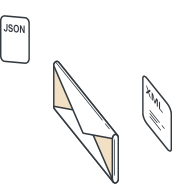
Open Trip Model integration
Not every partner is on the Open Trip Model. Some still send PDF and email. Chainfill delivers OTM-compliant data from any source.
Source-agnostic
Incoming streams
PDF, email, or legacy EDI in
OTM-compliant
Output
The schema your TMS expects
OTM is the modern standard, but the chain isn't on the same page
Open Trip Model is an open, JSON-based exchange model for logistics data. It is built for real-time collaboration over REST/JSON instead of batch EDI, and is positioned as the modern successor to classical EDI formats in the Dutch logistics sector.
In practice, part of the chain is on OTM and part is not. Smaller forwarders, foreign carriers, and one-person partners still send PDF, email, or legacy EDI. A team that consumes OTM often only sees half of the stream arrive in the right format.
Bridging non-OTM sources into the OTM stream
PDF orders
Forwarders and one-person partners
Email + attachments
Shippers without API access
Legacy EDI
EDIFACT, X12
Existing OTM feed
Partners already on OTM
Chainfill OTM bridge
One OTM-compliant stream
Partners that still send PDF, email, or legacy EDI are extracted and mapped into OTM-compliant payloads. Your TMS sees one schema regardless of where the order entered the chain. The bridge to Open Trip Model is the same: one extraction layer turns mixed inbound streams into the OTM payloads downstream systems already understand.
Where OTM stalls in practice
- 01
Not every partner supports OTM. Smaller forwarders and foreign partners still send PDF and email.
- 02
TMS systems that can consume OTM receive non-OTM input and end up translating manually.
- 03
Hand-written mappings between legacy formats and OTM break with every schema change.
From mixed input to one OTM stream
- 1
Capture every source
Non-OTM streams (PDF, email, EDIFACT, X12, CSV) land in the same inbox as your existing OTM feed.
- 2
Extract to structured fields
AI recognises field meaning regardless of layout, including the partner-specific terminology your TMS expects normalised.
- 3
Map to OTM
Validated fields are projected onto the OTM schema your TMS or integration layer consumes. Versioning is aligned per customer, so no team gets a forced OTM upgrade or schema mismatch.
- 4
Hand off to your TMS
Records land in OTM format alongside your existing OTM partners. Downstream consumers see one uniform stream.
Ready to remove the manual work?
Book a demo“Chainfill helps us process complex orders where the information is spread across documents and email threads.”
One schema, regardless of how partners deliver
What consuming OTM looks like once Chainfill takes over the source-side translation.
Mixed input
PDF, email, EDIFACT, CSV and OTM all mixed in. Your TMS or integration layer still translates per stream.
Uniform OTM
Non-OTM sources are extracted and passed through in OTM format. Your TMS sees one schema.
Conceptual framing: OTM stays the schema your TMS consumes. Chainfill fills the gap for partners not on OTM yet.
Your TMS or integration layer sees a single uniform OTM stream, whether the partner is on the standard yet or still sends PDF attachments. The bridge moves with you as more of the chain migrates.
Conceptual, based on OTM positioning.