EDI alternative: partner onboarding in days
Classical EDI takes four to twelve weeks per partner. Chainfill onboards partners in days by letting the mapping be learned instead of built.
Days
Partner onboarding
Not weeks per partner
One platform
EDI, PDF and email
For every incoming format
EDI covers only a fraction of freight traffic
Classical EDI works fine for the first twenty large, stable partners. But the vast majority of Dutch freight traffic still lives outside structured digital formats. In 2022, 638,852 eCMRs were issued in the Netherlands, just over 1% of all freight notes. The rest still runs on paper, PDF, email, or partner-specific layouts.
For forwarders and transport companies with many smaller partners that means: you only roll out classical EDI profitably for the top of your partner base. The long tail stays manual: four to twelve weeks of IT work per new EDI partner is rarely justifiable there.
How Chainfill replaces the classical EDI handoff
Partner documents
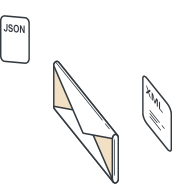
EDIFACT, X12, XML, PDF, email
- Read & normalise
Chainfill AI
Extract, validate, map
- Validated rows
Your ERP, TMS or WMS
Schema your stack already accepts
Documents in any format pass through one AI pipeline directly into your existing ERP, TMS or WMS. No partner-specific broker, no hand-written mapping per stream. For the long-tail partner base, that pipeline is the practical EDI alternative: same TMS schema, none of the per-partner integration cost.
Why classical EDI no longer fits
- 01
Four to twelve weeks per new partner. IT projects and regression tests every single time.
- 02
Hand-written mappings that silently break under schema drift. A partner renames a field and the delivery fails downstream with no clear error.
- 03
Three different products for EDI, PDF, and email: three teams, three SLAs, three sets of bugs.
How a new partner gets onboarded
- 1
Hand over two samples
Forward two real documents from your new partner in whatever format they send. No spec exchange, no template build-out.
- 2
AI proposes the mapping
Chainfill recognises the profile, suggests field mappings, and surfaces splits, concatenations, and array iterations in a diff view. When a partner later renames a field or changes a type, Chainfill warns before the order breaks downstream.
- 3
Verify in the mock server
Run the proposed mapping against the partner's real schema in the built-in mock server. Adjust where needed before anything goes live.
- 4
Go live in days
Switch the connection on via HTTPS or SFTP. No waiting in line behind other IT work, no regression suite per partner.
Ready to remove the manual work?
Book a demo“Since going live in October, Hartog Transport now processes 90% of its order flow automatically with Chainfill. A process that previously required many manual steps has become a much more efficient and scalable way of working.”
Partner onboarding before and after Chainfill
Classical EDI onboarding is an IT project per partner. Chainfill makes it ops-driven. This is the lead-time difference.
4–12 weeks
IT project per partner: exchange spec, hand-written mappings, change-control, regression testing.
Days
You hand over two sample documents, AI proposes the mapping, you verify in the mock server and go live via HTTPS or SFTP.
Lead time based on classical EDI-VAN onboarding cycles of 4–12 weeks, versus days for ops-driven onboarding. Lead time improves further as Chainfill learns from supervised corrections.
You can onboard roughly five partners in the time one classical EDI project takes, with mappings that keep adapting as partner formats drift instead of breaking quietly. That changes which partners are worth digitising at all.
Lead times compared with classical EDI-VAN onboarding.