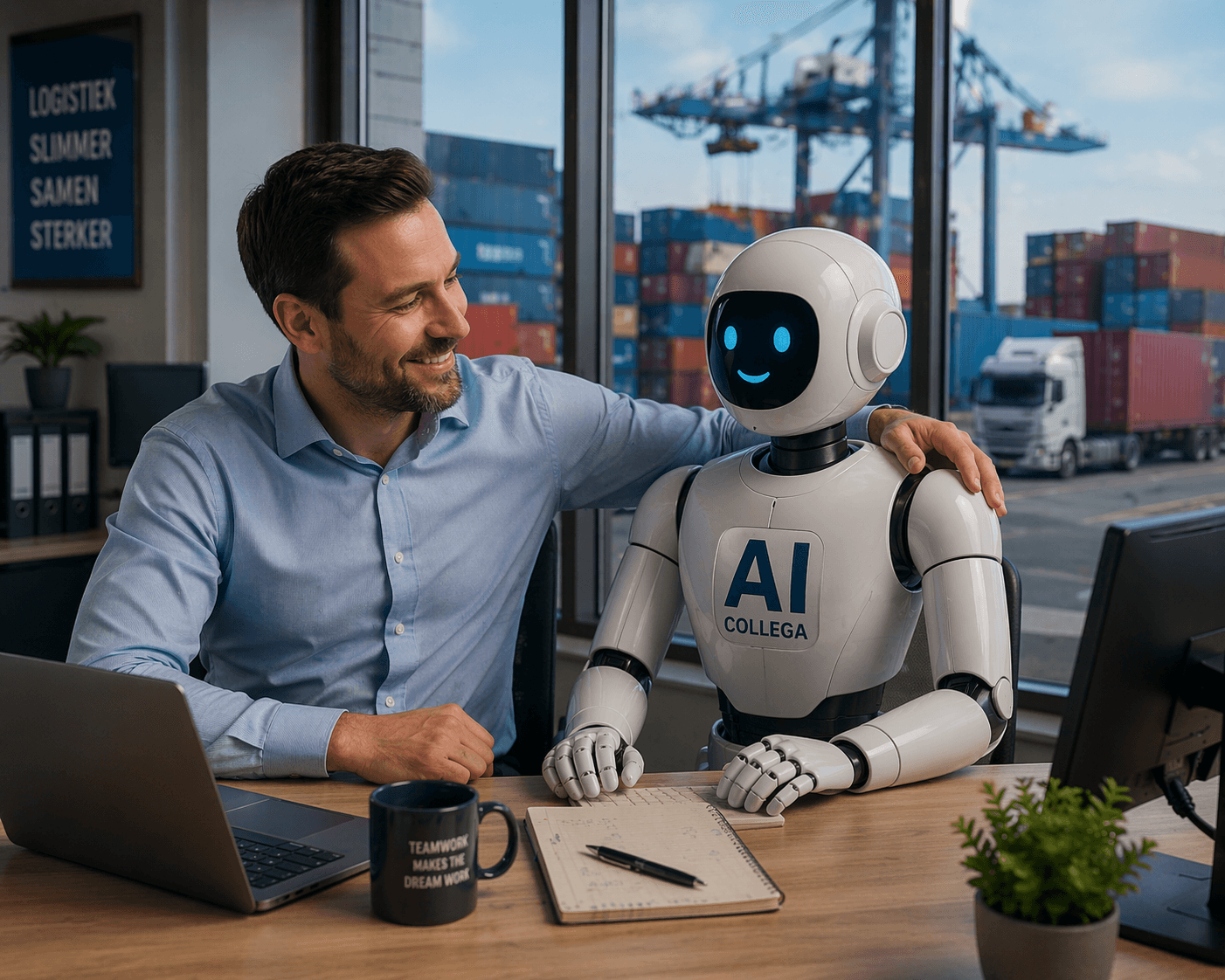
AI as a Colleague, Not a Tool

AI is still often seen as a tool - something you pick up when you need it. A utility that occasionally helps speed up a task. But that perception is becoming increasingly outdated. AI is evolving into something else: a digital colleague.
From tool to team member You shouldn’t think of AI as just another piece of software, but rather as a member of your team.
AI is a colleague that reads emails, processes orders, checks data, and updates systems, not just once, but continuously. At scale and without delay.
That is exactly what AI is already capable of today.
Research and real-world applications show that AI is increasingly being used as part of workflows, not as a standalone tool, but as an integrated “digital employee” within organizations.
A colleague without fatigue The difference compared to a human colleague is clear.
This digital colleague doesn’t need breaks, because it doesn’t get tired.
As a result, it also avoids unnecessary errors caused by fatigue.
This colleague can operate continuously throughout the entire day. It doesn’t need to go home or spend time with family.
Where humans struggle with repetition and volume, AI continues to perform consistently.
This is why AI is increasingly being deployed as structural support within teams, especially in administrative and operational processes.
Not replacing, but relieving AI doesn’t replace people, it redistributes work.
Repetitive and predictable tasks are increasingly being taken over. Think of entering and verifying data, processing standard emails, generating reports, handling order processing, and updating systems.
This creates more room for work that remains inherently human. There is more time for customer interaction, handling exceptions, planning and coordination, and decision-making and strategy.
AI doesn’t take away jobs, it takes away the noise around them.
The real shift: how work is organized The biggest impact of AI isn’t in a single tool, but in how companies organize their work.
Organizations that are ahead of the curve don’t use AI as a standalone solution, but as part of their team structure. AI becomes a permanent layer within processes, like a team member that is always available.
More and more companies describe this as the rise of the “digital colleague” within operational teams.
AI is not just a tool, it is becoming a structural part of how work gets done. By integrating AI as a digital colleague, organizations can reduce repetitive workload, improve consistency, and create space for more meaningful, human-centered work.