The new standard for EDI starts here

EDI is supposed to accelerate processes, but for many companies, it still feels like a brake. With Chainfill, we are building a new way of working where integrations happen naturally.
EDI has existed for decades and is deeply embedded in how companies communicate with one another. Orders, invoices, and shipping messages move between systems every day without anyone consciously thinking about it. At least, that’s the idea.
In reality, EDI still feels heavy and slow for many organizations. New integrations take time, mappings are set up manually, and communication with partners happens through long email threads where details get lost or misinterpreted. What was once intended to automate processes often still results in dependency and delays.
Meanwhile, the world in which EDI operates has changed. Companies move faster, work with more partners, and expect flexibility from their systems. Integrations should no longer take months, but days. At the same time, the knowledge required to build integrations often still resides with a small group of developers, while the actual need lies within the business.
This tension is becoming increasingly visible. On the one hand, the reliance on data exchange continues to grow; on the other, the way we organize that exchange is falling behind. That is exactly the point at which we started building.
Chainfill originated from a simple observation: the problem is not EDI itself, but how we work with it. Why should something that essentially revolves around translating data be so complex? Why is so much manual effort required to get two systems to communicate?
Instead of making EDI more powerful, we set out to make it simpler—not by removing functionality, but by fundamentally rethinking the way it works.
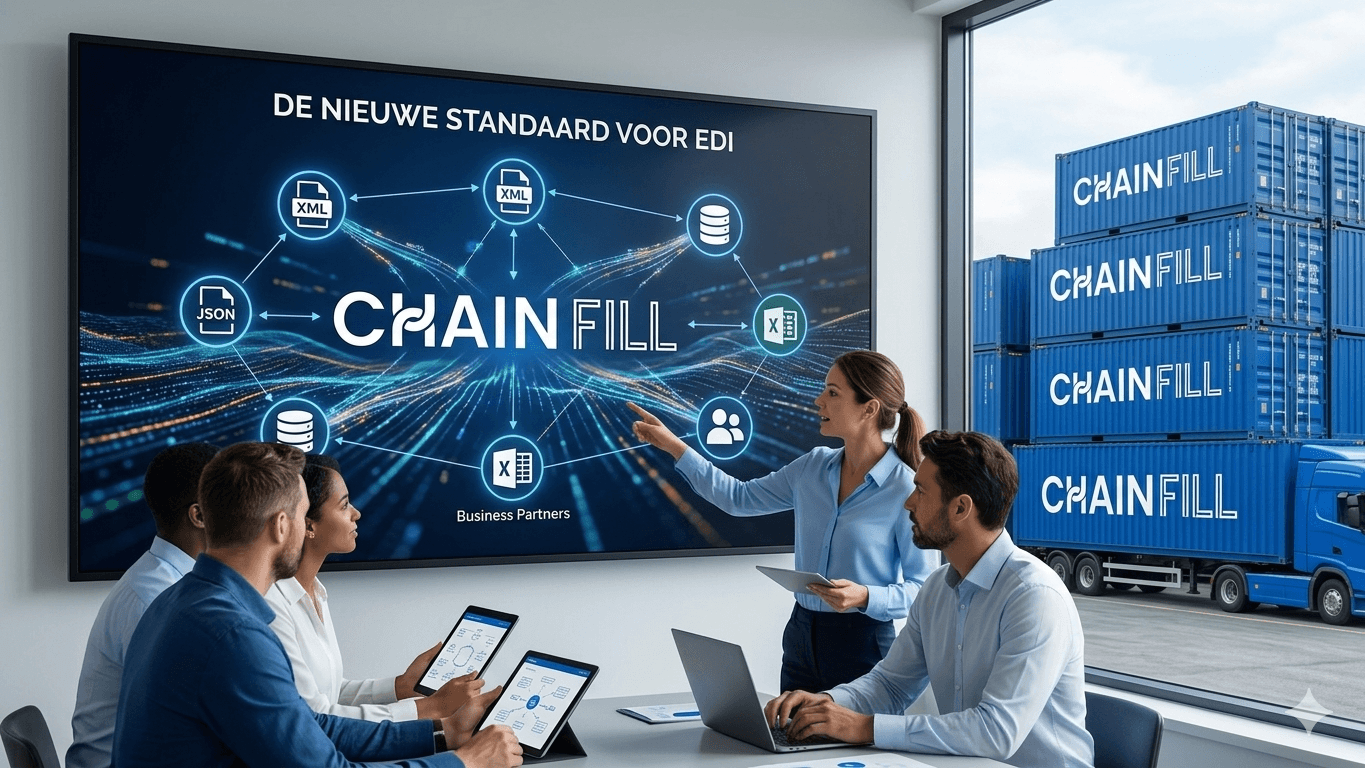
With the Chainfill EDI platform, the starting point shifts. Instead of manually creating mappings, the process begins with the data itself. When a customer provides a file—whether XML, JSON, or an Excel file—the structure is automatically understood and translated into a working integration. What used to be technical work becomes a logical extension of the input.
But data alone does not tell the whole story. A large part of EDI implementations is hidden in communication. Specifications are discussed via email, exceptions are added later, and changes remain buried somewhere in an inbox. This is where a lot of time is lost.
That is why we made communication part of the integration. When there has been contact with a customer about an integration, the agent can incorporate that context—not only to understand messages, but also to respond to them and process their content directly within the integration. What were once separate steps become a single continuous process.
The impact of this is greater than it may seem at first glance. Not only does it accelerate implementation, it also removes a significant risk. Differences in interpretation disappear because context is always included. The integration evolves alongside reality instead of lagging behind it.
At the same time, it changes who can work with EDI. What was once primarily a technical domain is now accessible to the teams who deal with these processes every day. People who understand what needs to happen can now make it happen themselves. This reduces the gap between idea and execution.
What does not change is the need for control. EDI remains a critical part of operations, and visibility is essential. That is why we built monitoring and analytics in from the start—not as an add-on, but as an integral part of the platform. You can see what is happening, when it is happening, and where something might go wrong.
The combination of automation, context, and insight creates a different dynamic. Integrations are no longer projects, but a continuous process that adapts to the needs of the business.
When we first opened access to the platform, we expected interest. We had already seen that the demand for a different approach was growing. Still, we were surprised by the speed at which companies signed up. Within a few days, most of the available spots were filled, and registrations came not only from our existing network, but also from far beyond it.
That confirms what we had already suspected: the need for a new way of working with EDI is greater than we thought. Companies are not looking for heavier tooling, but for a smarter approach—not more complexity, but less.
EDI is at a turning point. The technology itself is not the problem, but the way we work with it is. By placing automation, context, and ease of use at the center, a new standard is emerging—one in which integrations become faster, more accessible, and more flexible.
With Chainfill, we are taking a step in that direction. Not by reinventing EDI, but by finally making it work the way it was always meant to.